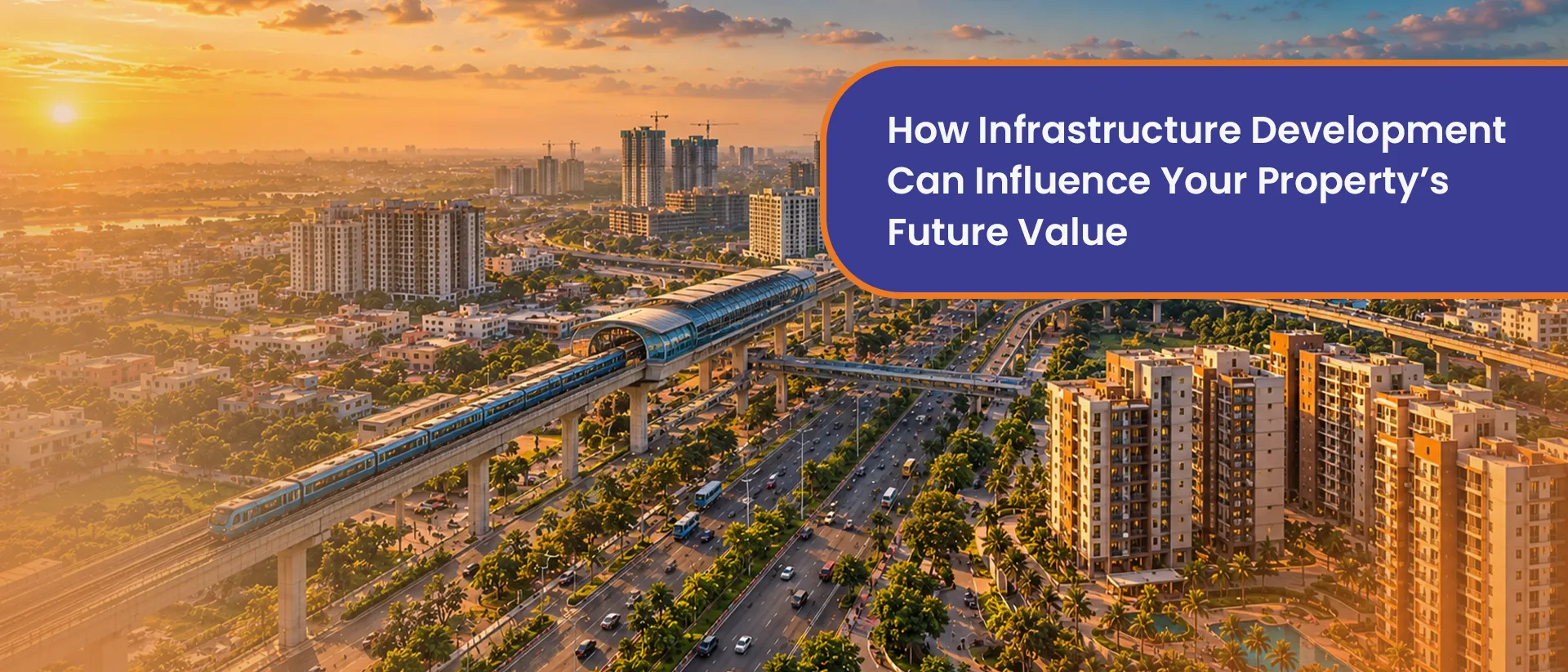
Home Property in Chennai How Infrastructure Development Can Influence Your Property’s Future Value
When buying a property, most people focus on the current price, location, amenities, and apartment size. However, one factor that can have a significant impact on a property’s long-term potential is infrastructure development.
Road expansions, improved public transportation, new commercial centres, educational institutions, healthcare facilities, and better connectivity can gradually transform a neighbourhood. As an area becomes easier to access and more convenient to live in, demand for housing may increase, which can influence property values over time.
For homebuyers and investors, understanding this relationship can help them make more informed decisions. A property located in a developing neighbourhood may offer a different long-term opportunity from one located in an already mature area.
Here are five frequently asked questions that explain how infrastructure development can influence the future value of a property.
Connectivity is one of the most important factors affecting residential property demand. When a neighbourhood gains better road access or improved public transportation, travelling to workplaces, schools, shopping areas, and other parts of the city becomes easier.
For example, a new road, flyover, metro connection, railway improvement, or expanded bus network can reduce travel time between a residential area and major employment hubs. This can make previously less accessible neighbourhoods more attractive to homebuyers.
Convenient connectivity also expands the practical area within which people are willing to purchase a home. A buyer may be comfortable living farther from their workplace if reliable transportation makes the daily commute manageable.
As more people consider an area, demand for housing can increase. Higher demand, combined with limited availability of well-located properties, may support price appreciation over the long term.
However, buyers should distinguish between announced infrastructure and completed infrastructure. A proposed project may take several years to materialise, and some projects may experience delays. Therefore, purchasing a property solely because of a future infrastructure announcement can involve considerable uncertainty.
It is better to assess both present-day connectivity and the credibility, progress, and likely impact of proposed projects.
For people comparing apartments in Chennai, for instance, looking at proximity to major roads, public transport, employment corridors, and upcoming infrastructure can provide useful insight into a property’s long-term residential appeal.
Infrastructure is not limited to roads and transportation. Social infrastructure can be equally important when determining how desirable a residential location becomes.
Schools, colleges, hospitals, supermarkets, shopping centres, restaurants, recreational facilities, banks, and other essential services contribute to the overall liveability of a neighbourhood.
Consider a developing residential locality where several housing projects are being constructed. Initially, residents may have to travel some distance to access everyday services. As the population increases, businesses and service providers may recognise the growing demand and establish facilities nearby.
This creates a positive cycle. More residents encourage businesses and institutions to establish themselves in the area. Better amenities then make the neighbourhood more attractive to additional homebuyers. Increased residential demand can subsequently support the area’s real estate market.
Healthcare and education are particularly influential. Families often prioritise access to reputable schools and hospitals when choosing where to live. A neighbourhood that offers these facilities within convenient travelling distance can therefore become more attractive to end-users.
The same applies to retail and recreational infrastructure. Shopping centres, supermarkets, restaurants, parks, fitness centres, and entertainment facilities can make everyday life more convenient.
When assessing a property’s future prospects, buyers should therefore look at the complete ecosystem surrounding the property, rather than focusing exclusively on the apartment itself.
Residential demand is closely connected to employment opportunities. When new IT parks, industrial areas, business districts, office complexes, or commercial centres emerge in or around a locality, they can attract employees from different parts of the city. Many of these workers eventually look for homes closer to their workplace to reduce commuting time and transportation costs.
This can increase demand for rental housing as well as properties available for purchase.
Commercial development can also have a broader economic impact. New businesses may create jobs and attract supporting services such as restaurants, retail outlets, educational facilities, healthcare providers, and transportation services.
As the employment ecosystem becomes stronger, the neighbourhood may gradually evolve from a primarily residential or peripheral location into a more self-sufficient urban destination.
For property owners, this can be beneficial because homes located close to employment centres may remain attractive to both tenants and future buyers.
However, proximity should be evaluated carefully. Being close to a commercial hub can be an advantage, but excessive traffic, noise, congestion, or industrial activity may negatively affect residential appeal.
The ideal situation is often a property that provides convenient access to employment centres while maintaining a comfortable residential environment.
Homebuyers should therefore consider the type, scale, and sustainability of commercial development, rather than assuming that every new commercial project will automatically increase property prices.
No. Infrastructure development can improve a property’s prospects, but it does not guarantee a rise in property value.
Property appreciation depends on multiple factors working together. Infrastructure is one important component, but location, supply and demand, economic conditions, property quality, developer reputation, local regulations, employment growth, and overall market sentiment also play important roles.
For example, a new road may improve access to a locality, but if the area has excessive housing supply and limited employment opportunities, property prices may not increase significantly.
Similarly, a major transportation project may benefit one part of a neighbourhood more than another. A property located close to a convenient access point could potentially enjoy greater benefits than one located much farther away.
The quality of the infrastructure also matters. Better roads, reliable public transportation, efficient drainage, electricity supply, water availability, and waste management can improve everyday living conditions. Poorly planned development can instead create congestion or other challenges.
Buyers should therefore avoid making decisions based on a single infrastructure project.
A better approach is to assess whether multiple forms of development are occurring together. When transportation, employment, education, healthcare, retail, and residential development grow simultaneously, the potential for a more sustainable neighbourhood ecosystem may be stronger.
It is also important to remember that property is a long-term asset. Short-term price movements can be influenced by market cycles, while meaningful infrastructure-led transformation can take several years.
Buying a property in a developing area can offer potential advantages, but it requires careful research.
The first step is to examine the current infrastructure. Buyers should assess road quality, public transport, water supply, electricity, drainage, internet connectivity, schools, healthcare facilities, and shopping options.
The second step is to research planned infrastructure. Buyers should look at whether proposed roads, transport projects, business parks, educational institutions, or other developments have progressed beyond the announcement stage. Official approvals, construction progress, funding, and expected completion timelines can provide a clearer picture.
Location within the neighbourhood is equally important. A property may technically be located in a developing area but still be poorly connected to its key infrastructure. Buyers should therefore evaluate actual travel distances and commute times rather than relying only on the locality’s name.
The property’s quality should also be considered independently of infrastructure. Construction standards, floor plan efficiency, ventilation, natural lighting, amenities, maintenance arrangements, parking, legal approvals, and the developer’s track record all influence long-term value.
For example, MP Developers is one of the names prospective buyers may encounter while researching residential developments, but buyers should always conduct independent due diligence and compare projects based on location, documentation, specifications, quality, and overall value.
Another important consideration is future supply. If a locality has numerous large residential projects under development, the increase in housing supply could influence future appreciation and rental demand. Buyers should understand the balance between expected population growth and upcoming housing inventory.
Finally, buyers should have realistic expectations. Infrastructure can improve the attractiveness and utility of a neighbourhood, but property appreciation is never guaranteed. The strongest decisions usually come from evaluating the property’s fundamentals rather than relying solely on projected future prices.
Infrastructure development can play a powerful role in shaping a property’s future value because it influences connectivity, convenience, employment opportunities, social infrastructure, and overall liveability.
A neighbourhood that was once considered distant or inconvenient can become increasingly desirable when transportation improves and essential services and employment opportunities follow. This transformation can create stronger demand for residential properties over time.
However, infrastructure should be viewed as one part of a broader property evaluation. Buyers should consider existing facilities, planned projects, employment growth, housing supply, property quality, developer credibility, and their own long-term requirements.
Ultimately, the best property decisions are not based simply on what an area may become. They combine the benefits available today with credible evidence of how the neighbourhood is likely to develop tomorrow.
1. How does infrastructure development affect property value?
Better roads, transportation, and connectivity can increase a location’s accessibility and attract more homebuyers, potentially supporting long-term property value.
2. Does improved public transportation increase residential demand?
Yes, better public transportation can reduce commuting time and make a neighbourhood more convenient, increasing its appeal to buyers and tenants.
3. Can schools and hospitals influence property prices?
Yes, access to quality schools, hospitals, shopping, and other essential facilities can improve a neighbourhood’s liveability and residential demand.
4. Does upcoming infrastructure guarantee property appreciation?
No. Infrastructure can improve future prospects, but property appreciation also depends on demand, supply, location, economic conditions, and overall development.
5. What should buyers check before investing in a developing area?
Buyers should evaluate existing and planned infrastructure, connectivity, amenities, employment opportunities, property quality, approvals, and the developer’s reputation.