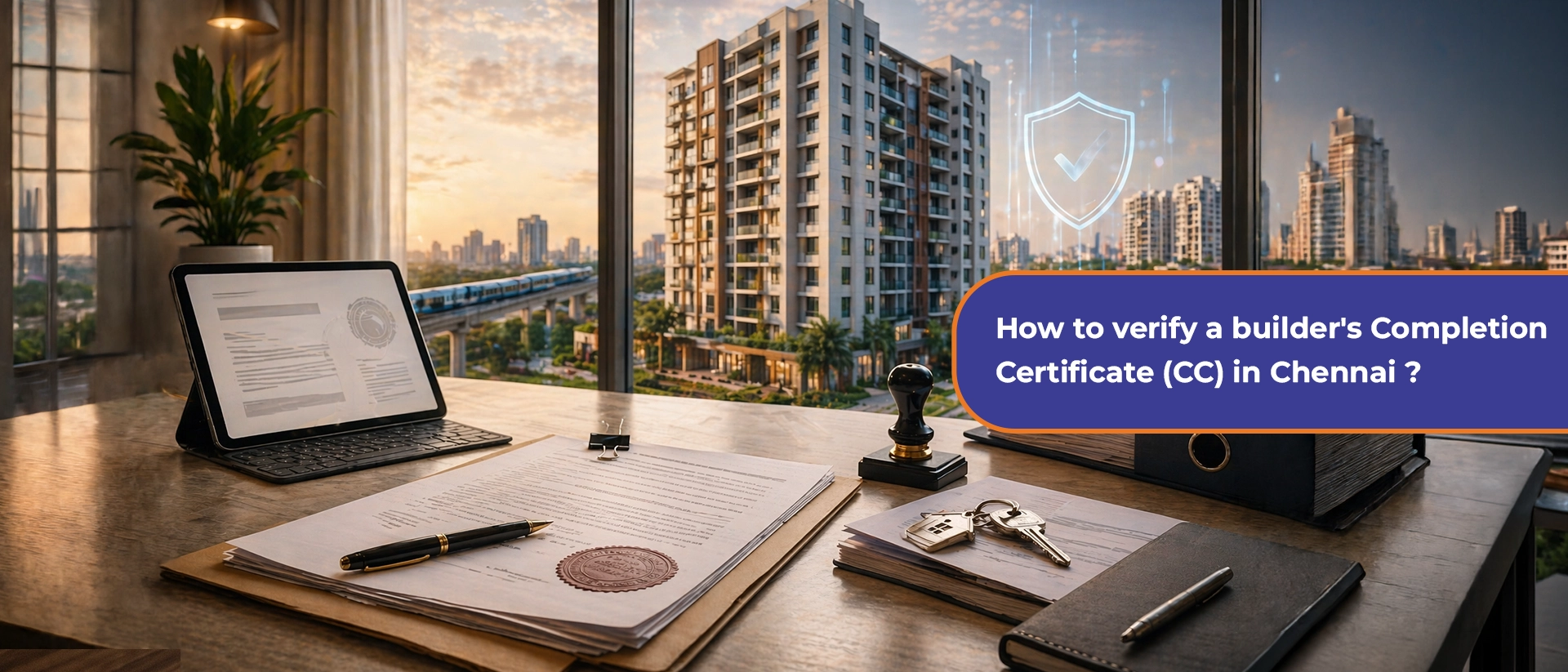
Home Property in Chennai How to Verify a Builder’s Completion Certificate (CC) in Chennai
Buying a home in Chennai is not just about location, design, or price. One document that quietly decides how safe your investment is the Completion Certificate, often called CC. Many buyers hear about it but do not fully understand how to check it or why it matters so much. This is where most problems begin.
If you are planning to buy an apartment or a villa, knowing how to verify a builder’s Completion Certificate in Chennai can save you from future legal issues, loan problems, and even resale trouble.
A Completion Certificate is issued by the local authority after inspecting the building. It confirms that the construction is done as per the approved plan and follows all rules.
In Chennai, this certificate is usually issued by the Greater Chennai Corporation or the Chennai Metropolitan Development Authority depending on the project.
In simple words, CC means:
Without this certificate, the property is technically not fully approved.
Many buyers ignore this step, especially when the building looks complete and ready. But skipping CC verification can lead to serious issues later. Here is why it matters:
1. Legal safety
Without CC, the construction may have violations. This can lead to penalties or even demolition notices in extreme cases.
2. Home loan approval
Banks usually check CC before approving loans. Even if a loan is given, resale buyers may face issues.
3. Water and electricity connections
Permanent utility connections are often linked with CC approval.
4. Resale value
Properties without CC are harder to sell and usually get lower value.
Before getting into verification steps, it helps to know where people go wrong.
These small misses can turn into big problems later.
1. Ask for a Copy from the Builder
Ask the home builder or developer in Chennai for a copy of the Completion Certificate.
Check if:
Do not rely on screenshots or partial copies. Always ask for a full document.
2. Cross-Check with CMDA or Corporation
Once you have the copy, verify it with the issuing authority.
If the project falls under CMDA approval, check with Chennai Metropolitan Development Authority. If it is within city limits, check with Greater Chennai Corporation.
You can:
This step ensures the certificate is not fake or altered.
3. Match with Approved Building Plan
This is a step many buyers skip. Ask for the approved building plan and compare it with the actual construction.
Check for:
If there are major differences, it means the builder may not have followed approved rules, even if a certificate is shown.
4. Check for Deviations or Violations
Even if a CC is issued, there could be minor deviations. But large deviations are risky. Look for:
If you are unsure, take help from a civil engineer or legal expert to review the property.
5. Verify Through RERA Records
Projects registered under Tamil Nadu Real Estate Regulatory Authority will have project details listed online.
Check:
If the project is marked as completed but CC is missing or unclear, that is a red flag.
6. Speak to Residents or Association
If the building is already occupied, talk to residents or the association.
Ask simple questions:
7. Get Legal Verification
This is the safest step, especially for high-value purchases.
A property lawyer can:
This may cost a small fee, but it can save you from bigger losses.
Many buyers think both are the same. They are not.
Completion Certificate (CC): Issued when construction is completed as per plan.
Occupancy Certificate (OC): Issued after confirming the building is safe to live in.
In many cases, OC is issued after CC. For buyers, having both is ideal.
If a property does not have a CC, here is what you may face:
In some cases, buyers try to regularise such properties later, but it involves extra cost and uncertainty.
At MP Developers, we understand that buyers today look beyond just design and pricing. Clear approvals, proper documentation, and transparent processes matter just as much.
If you are exploring apartments in Chennai and want guidance on verified properties, feel free to connect with us. We are happy to help you make a confident and informed decision.
1. How to check completion certificate of builder?
Ask the builder for a copy of the Completion Certificate first. Then verify it with the issuing authority like the Greater Chennai Corporation or Chennai Metropolitan Development Authority. Check if the project name, address, and approval details match. You can also compare it with the approved building plan to see if everything is built as per rules.
2. How to check CC in RERA?
Visit the website of Tamil Nadu Real Estate Regulatory Authority and search for the project using its name or registration number. In the project details section, check the status and documents uploaded by the builder. If the project is completed, the Completion Certificate details should be available there.
3. What is the difference between OC and CC certificate?
A Completion Certificate (CC) confirms that the building is constructed as per the approved plan. An Occupancy Certificate (OC) confirms that the building is safe and ready for people to live in. CC comes first, and OC is issued after final safety checks.
4. Who issues a certificate of completion?
The Completion Certificate is issued by the local authority after inspection. In Chennai, it is given by the Greater Chennai Corporation or Chennai Metropolitan Development Authority depending on the project approval.
5. Is it okay to buy a flat without OC?
It is not recommended. Without an Occupancy Certificate, the building may not be fully approved for living. You may face issues with home loans, water and electricity connections, and resale. It is always safer to buy a flat with both CC and OC.