

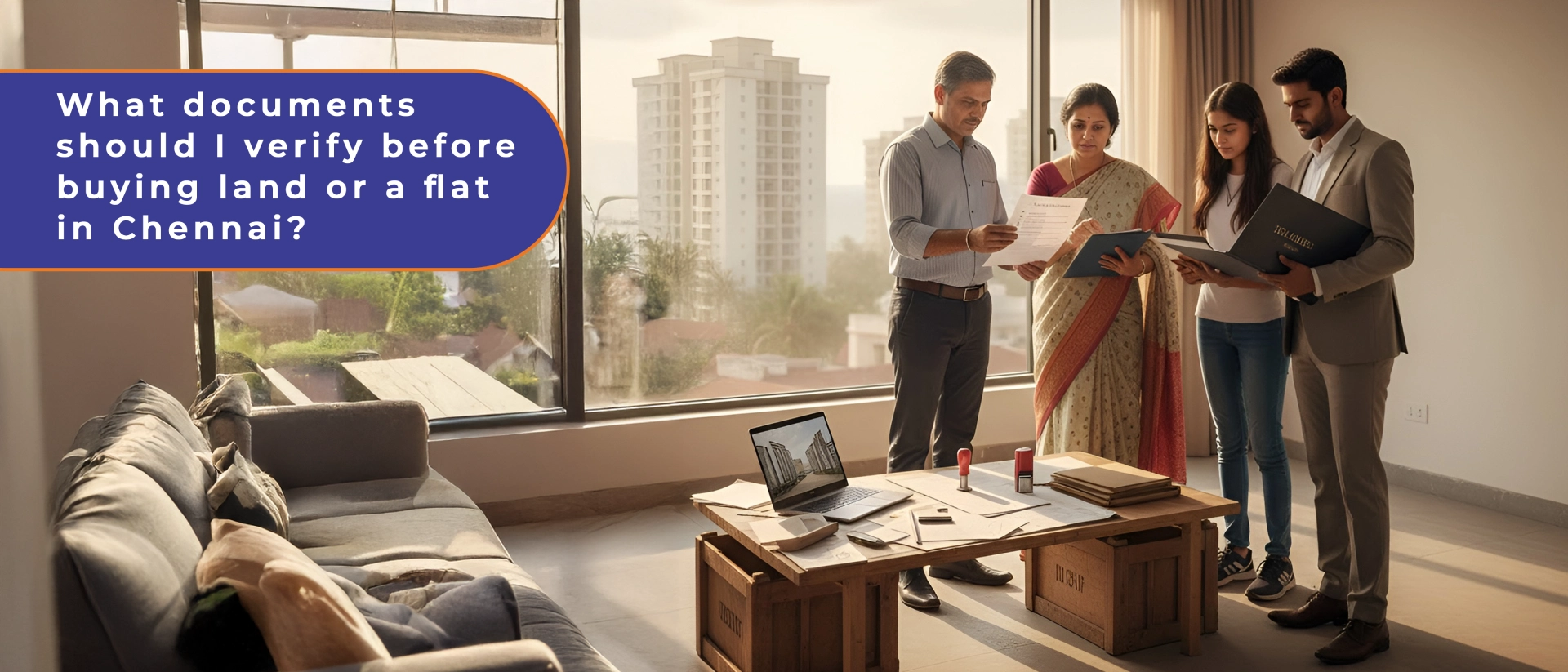
What documents should I verify before buying land or a flat in Chennai?
Owning a flat or land is more than just a dream to many of us; when it’s time to make the dream come true, nothing can match and nobody can contain the happiness and the excitement, and this is where the buyer almost forgets the most substantial step. That is, the document verification. And that’s normal; the thrill of buying your ideal home, securing a long-term investment, or purchasing an apartment for your family is often accompanied by some anxiety: all you hear yourself say is, “Am I making the correct decision?”
In cities like Chennai, where new developments keep arising and every builder guarantees “the best deal”, it’s crucial to comprehend the fundamentals, particularly the documents you need to go through and confirm.
When buying a flat, we use different modes of transaction with our hard-earned money. But there is something more important, as equal as that is: knowing whether every aspect of the property is legally clear, approved, and certified. Most importantly, it assures you that your hard-earned money is secure.
Why Document Verification Matters
The real concern is that many homebuyers think that the process of document verification is not that important, but the matter is, it is really a crucial step while buying a property. Particularly in developing areas like Pallavaram, Sholinganallur, Tambaram, and Perungalathur, Chennai’s real estate market has expanded quickly. Although this presents excellent financial prospects, it also raises the possibility of running into unapproved blueprints, invalid permissions, and false builder claims.
And to avoid these kinds of problems, selecting a trusted builder in Chennai, such as MP Developers, together with careful paperwork checks, may provide you with complete peace of mind. Recent reports say that ignoring appropriate document verification can greatly raise the danger of legal troubles because many of these disputes are caused by problems like unclear title, missing documentation, inheritance claims, informal/unregistered transfers, or overlapping claims.
Step-by-step document verification guide
1.Parent Document (Mother Deed)
The mother deed, also known as the parent document, acts as the foundation of property ownership. It displays the property’s entire ownership history over time. This document indicates whether the title was transferred correctly and where the seller purchased the property.
Why it matters
- Guarantees the continuity of the ownership chain
- Aids in verifying the seller’s authority to sell
- Removes any unstated disagreements or assertions
How to verify
Request the Mother Deed’s original or certified copy. Examine it with a legal professional to make sure all of the chain’s transactions are properly recorded.
2.Encumbrance Certificate (EC)
One of the most important property documents is an encumbrance certificate. An encumbrance certificate displays every registered transaction pertaining to the property or unit, such as:
- Previous sales
- Bank loans or mortgages
- Legal attachments
Why it matters
The encumbrance guarantees that there are no debts, disagreements, or financial obligations associated with the property. And it is encumbrance-free and ready to occupy or buy.
How to verify
Always ask for the encumbrance certificate for the past 20 to 30 years. Verify that every transaction number corresponds to the sale deed and mother deed.
3.Patta Chitta & Adangal (For land purchases)
These three documents are required while purchasing land in Chennai (Tamil Nadu), particularly in emerging neighbourhoods.
Patta – A crucial legal document in India, the Patta is mostly connected to the state of Tamil Nadu and provides obviously required evidence of a person’s legal possession or title over a certain piece of land. The owner’s name, the unique Patta number, the land’s exact location and classification (such as residential or agricultural), the survey number and subdivision, and the total area of the property are all included in the Patta, etc.,
Chitta – In Tamil Nadu, Chitta was a distinct land revenue document that gives information about the land’s extent, ownership history, and classification, mainly classifying it as either Punjai (dry land) or Nanjai (wetland).
Note: In order to make things easier, the Tamil Nadu government combined the Chitta and Patta documents in 2015. As a result, they are now published as a single, all-inclusive document.
Adangal – In Tamil Nadu, the Village Administrative Officer maintains an important ‘agricultural and revenue register’ called ‘Adangal’.
A particular land’s current usage and cultivation details are tracked in this document. Its main purpose is to document the area under cultivation, the current status of the land, and the crops grown during a particular agricultural year.
Why they matter
They assist you in knowing:
- Who is the landowner?
- The legal classification of the land
- Is it suitable for home use?
These documents defend you from purchasing land that is restricted or held by the government.
4.CMDA / DTCP Approval
Depending on the area, Chennai’s layout approval is managed by either the Directorate of Town and Country Planning (DTCP) or the Chennai Metropolitan Development Authority (CMDA).
Why it matters
- Verifies the plot is legal divided
- Keeps you from purchasing unapproved plots.
- Increases loan eligibility and resale value
Banks may reject loans if a layout is not CMDA or DTCP approved, and you may later run into legal problems.
How to verify
Obtain: Ask the seller for the Official Approval Number (DTCP/CMDA).
Check: To verify the legitimacy of the document, compare this number with the survey number found in the “Approved Layouts” section of the official DTCP/CMDA websites.
Lastly, present the validated documents to a real estate attorney or property lawyer.
5.Building Plan Approval
When buying a flat, make sure the builder has a building plan that has been approved by the government.
This covers the structural layout, parking space, setbacks, and authorised number of floors, and every other important detail you need to know about the property before proceeding to buy.
Why it matters
A breakdown from the authorised plan helps you in knowing
- Notices of demolition
- Penalties
- Loss of Occupancy Certificate (OC)
Make sure the plan clearance is legitimate before purchasing apartments in Pallavaram or anywhere else in Chennai.
How to verify
Obtain the Number: Get a copy of the approved plan and the official Approval Number.
Go Online: Go to the local authorising authority’s website.
Use the Approval Number or Survey Number to search their database and make sure the online record precisely corresponds to the constructed structure and the physical plan.
6.Title Deed / Sale Deed
The legal transfer of ownership from one individual to another is accomplished by this document. The Sub-Registrar’s office is where it should always be registered.
Why it matters
- Confirms legal ownership
- Required for resale
- Acts as the main proof of property transfer
How to verify
Check Chain: Verify 30 years of continuous ownership transfers by looking over the Title Deed and Mother Deed.
Encumbrance Check: To make sure there are no outstanding debts or mortgages, get a current Encumbrance Certificate (EC).
Cross-Match: Check the information (Survey No., Owner Name) against the records of Patta and the Sub-Registrar.
Legal Review: Consult a property attorney/property lawyer for final approval.
7.Completion Certificate (CC)
After the building is completed in accordance with the authorised plan, the local government issues the completion certificate.
Why it matters
- Verifies the building’s structural completion
- Ensures that construction adheres to legal requirements
- Banks may reject house loans or partial payments in the absence of a completion certificate.
How to verify
- Acquire the Application/Approval Number for the completion certificate
- Go to the applicable authority’s official website
- To search the online database, use the Approval Number or Survey Number.
- Make sure no unauthorised changes were made by comparing the online and physical records.
8.Occupancy Certificate
An Occupancy Certificate is issued by the authority once the building is finished and safe to occupy.
Why it matters
- Verifies the building’s safety for occupants
- Need for connections to power and water
- Verifies that no unlawful construction has taken place
- You should always examine the OC before taking ownership of a flat.
How to verify
- Use the Application ID/Project Name to visit the municipal corporation’s or RERA’s official website.
- Important Verification: Verify that the details (area, floors) match the actual structure and that the document is an unconditional final occupancy certificate.
9.RERA Registration
All real estate developments are required by the RERA Act to register with the Tamil Nadu RERA authorities.
Why it matters
- Ensures that the builder is transparent.
- Prevents fraud on your investment.
- Gives you access to project details, approvals, timelines, and promoter information
If you’re looking for trusted builders in Chennai, like MP Developers or others, always check whether their project is RERA-registered.
How to verify
- Ask the builder or promoter for the RERA Registration Number.
- Go to the official state RERA website (such as TNRERA or MahaRERA).
- In the “Registered Projects” area, search using the registration number or project name.
- Make sure the information provided by the builder and the project data on the website match.
About 116,300 homebuyer disputes have been settled under RERA in 27 states and 8 union territories as of November 2023 reports, demonstrating the prevalence of property-related problems prior to registration and regulation.
10.Property Tax Receipts & Utility Approvals
Make sure all municipal and basic utility payments are current before completing the purchase of your property. Verify that there are no outstanding payments from prior owners by looking at the most recent property tax receipts. Make sure that the property has the appropriate sewage/drainage, electricity board, and water connection approval from the local government.
These records guarantee that the property is lawfully maintained, free of unpaid bills, and prepared for hassle-free, safe living.
Why it matters
- Verifies that no taxes are outstanding.
- Demonstrates that utilities are authorised by law
- Stops you from receiving past dues
How to verify
- Obtain the Property Tax ID/Assessment Number from the seller.
- Visit the Official Municipal Corporation/ULB Website.
- Use the ID to view the payment history and status online.
- Confirm the owner name, property address, and payment dates match the physical receipts provided.
- Ensure all dues are clear and the receipts are genuine.
Final checklist of all the documents
- Mother Deed
- Encumbrance Certificate
- Patta, Chitta, Adangal
- CMDA/DTCP approval
- Approved building plan
- Sale Deed
- Completion Certificate
- Occupancy Certificate
- RERA registration
- Tax receipts and utility approvals
To conclude, purchasing land or an apartment in Chennai is a long-term investment that has the potential to influence your financial destiny. You may reduce dangers, guarantee legal security, and safeguard your hard-earned money with appropriate document verification.
This 10-step checklist can assist you in making a safe and knowledgeable purchase, whether you’re looking for apartments in Pallavaram, assessing the projects of MP Developers, or just looking for reliable builders in Chennai.
Frequently Asked Questions(FAQ)
1.How to verify a mother deed before buying a property in Chennai?
Check the original mother deed against registered sale deeds at the Sub-Registrar (or TNREGINET), confirm the chain of title, names and survey numbers, and have a lawyer review for gaps or forged entries.
2.How to get an encumbrance certificate in Chennai?
Request the EC from the Sub-Registrar or download via TNREGINET for the relevant period (20–30 years recommended) and look for mortgages, charges, or missing registered transfers.
3.How to verify patta chitta and adangal to buy a plot in Chennai?
You can use the Tamil Nadu e-Services / Patta-Chitta portal or visit the local Tahsildar/VAO office to confirm the owner name, land classification and land-use history; match these with sale deeds and EC.
4.How to check CMDA/DTCP approval for a flat in Chennai?
Ask the seller for the approval number and sanctioned plan, then cross-check with CMDA/DTCP records or their online approval search to confirm authenticity and scope of approval.
5.How to verify building plan approval in Chennai?
Get the approved plan copy and approval number from the builder, then verify it with CMDA/municipal/DTCP records to ensure built-up floors, setbacks and amenities match the approved drawing.
6.How to check the completion certificate and occupancy certificate status?
Request CC/OC numbers and copies from the developer; verify them against CMDA/municipal records; never accept possession without checking OC and CC if newly completed.
7.How to buy RERA-registered apartments in Chennai?
Search the Tamil Nadu RERA portal by project or promoter name to confirm the registration number, project status, disclosures, and any complaints against the promoter.
8.What to check before buying an apartment in Chennai?
Ask for the latest property tax receipts, TNEB (electricity) sanction, water connection and sewage/drainage approvals; unpaid taxes or missing utility NOCs are major red flags.
9.Is having a lawyer during land document verification important?
Yes, hiring a lawyer to verify title documents and sale agreements before paying any advance is important. Get a licensed surveyor to confirm physical boundaries, encroachments and matches with approved plans before registration and payment.
10.How long does the document verification take?
Verification can take days to a few weeks depending on records and legal review. Start with online checks (TNREGINET, Patta portal, CMDA, RERA) and then verify originals in person. Prioritize mother deed, EC, Patta, CMDA/DTCP approval, sale deed, CC/OC and RERA;















 Home
Home
 Menu
Menu


 WhatsApp
 Enquire